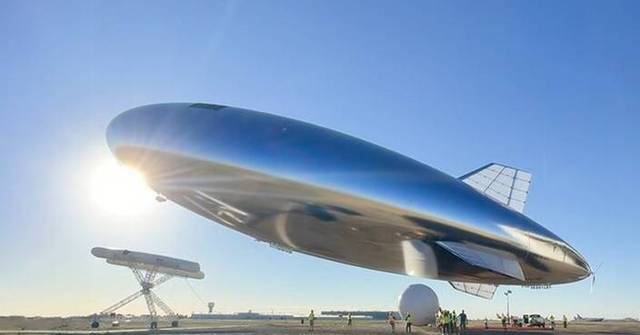
1. Specifications Explain What an Application Can Do
There's a tendency within the HAPS industry to talk about ambitions rather than engineering. Press releases talk about coverage zones Partnership agreements, coverage areas, as well as commercial timelines. But the most important and more interesting discussion is about specifications, what the vehicle actually holds, how long it actually stays up, and what energy systems make sustained operation feasible. For anyone trying figure out whether a platform that is stratospheric is really mission-capable or merely in the prototype phase, capacities for payloads, endurance estimates and battery performance will be the most important factors to consider. Inconsistent promises to "long endurance" and "significant payload" are not difficult to understand. Delivering both simultaneously at a high altitude is the challenge in engineering that separates credible programmes from more ambitious announcements.
2. The Lighter-than-Air Architecture Modifies the Payload Equation
The main reason why Sceye's airship design has the capacity to carry significant payload is because buoyancy performs the principal task of keeping the vehicle on air. This isn't an unimportant difference. Fixed-wing solar airplanes generate aerodynamic thrust continuously, which requires energy and has structural constraints which limit the extra mass the vehicle can sensibly transport. Airships that are floating in the stratosphere has no need to expend energy fighting gravity the same way as fixed-wing aircraft do -- thus the power generated by its solar array as well as the structural power of the vehicle is able to be utilized for propulsion, station-keeping, and the operation of the payload. It's the result of an increased payload capacity than fixed-wing HAPS designs with comparable endurance can't even come close to matching.
3. Capacity for Payloads Determines Mission Versatility
The importance of having a larger capacity payloads becomes evident when you take a look at what stratospheric needs missions really require. A payload in telecommunications - antenna systems or signal processing hardware beamforming equipment -- carries the real weight and volume. So does a greenhouse gas monitoring suite. And so does a wildfire identification of earth observation. Each of these missions properly needs hardware with a mass. It is necessary to perform multiple missions at the same time more. Sceye's airship requirements are formulated around the concept that a stratospheric platform should be able to carry a genuinely valuable combination of payloads rather than requiring users to choose between observation and connectivity since the vehicle won't be able to handle both simultaneously.
4. Endurance Is Where Stratospheric missions can win or lose
A platform that reaches stratospheric altitude for at least 48 hours before having to drop is useful for demonstrations. A platform that can remain in place throughout months or for weeks at and is suitable for making commercial services. The distinction between those two outcomes is basically an energy issue -- specifically, whether or not the vehicle is able to generate enough solar power in daylight to power all of its equipment and recharge its batteries enough to continue their full operation throughout the night. Sceye endurance targets are built around this diurnal challenge and treat the requirement for energy supply during the night not as a stretch target but rather as the primary principle that everything else must be built around.
5. A Genuine Step to a Change
The battery technology that powers conventional consumer electronics and electric vehicles -mainly lithium-ion. It has energy density characteristics that result in real difficulties for stratospheric endurance. Each kilogram of battery mass that's carried is an ounce not available for payloads, and yet you require enough energy stored in order to keep the large platform operating throughout a massive night. The chemistry of lithium-sulfur batteries alters this equation significantly. With energy densities approaching 425 Wh/kg, lithium-sulfur cells can store a significant amount of energy per unit of mass than similar lithium ion cells. If you're driving a car with a limited weight, and every milligram of the battery's mass has an opportunity cost in payload capacity growth in energy density won't be only incremental, but architecturally significant.
6. Improved Solar Cell Efficiency Are the other half of the Energy story
Battery energy density determines how much energy you have the capacity to store. The efficiency of solar cells determines the speed at which you replenish it. Both are essential, and improvement on one without advancing one leads to a split energy structure. New developments in high-efficiency solar cells that include multi-junction designs which capture a greater range of solar energy than standard silicon cells have significantly improved the amount of energy available to solar-powered HAPS vehicles at all hours. Combined with lithium-sulfur storage, these advances are what make the closed power loop feasible: creating and storing enough energy each day to run all systems for a long time without external energy input.
7. Station Keeping Draws Constantly Out of the Energy Budget
It's simple to think of endurance as merely being in the air, but for an ozone-based platform, being at sea is only a small part of the energy equation. Stationkeeping -- actively holding position against the winds of the stratosphere through constant propulsion draws power continuously and is large proportions of energy consumption. The budget for energy has to keep station keeping with payload operations, avionics, thermal management, and communications systems simultaneously. This is the reason why specifications that provide endurance figures without describing what systems are operating throughout the endurance period are difficult to evaluate. True endurance estimates assume full operational load and not a low-level configuration of the vehicle to coast with payloads off.
8. The Diurnal Cycle is the Design Constraint Everything Else is Flows from
Stratospheric engineers speak about the diurnal rhythm -- the day-to-day rhythm of solar energy supplyas the principal factor in the framework around which the platform is designed. When it is daylight the solar array has to produce enough power to run all the systems and recharge the batteries sufficiently. After dark, the batteries must be able to last until sunrise, without shifting, deteriorating load performance, or entering any reduced-capability state that would disrupt a continuous monitoring or connectivity mission. The design of a vehicle that can thread this needle with a high degree of reliability, day after day, for a long period of time is the most important engineering problem of solar-powered HAPS development. Every specification decision such as solar array size as well as battery chemistry, propulsion effectiveness, payload power draw -is a part of this rule of thumb.
9. This is because the New Mexico Development Environment Suits This Kind of Engineering
In the process of developing and testing a stratospheric airship requires airspace, infrastructure and atmospheric conditions that aren't always available. Skeye's home base is New Mexico provides high-altitude launch and recovery capabilities, crystal clear blue skies suitable for conducting solar experiments, which also gives access type of wide, uninterrupted airspace is required for continuous flight testing. Of the aerospace companies operating in New Mexico, Sceye occupies an unique position- focused on stratospheric lighter-than-air platforms, as opposed to the Rocket launch programs more commonly located in this region. The rigor of engineering required for the verification of endurance claims and battery performance in real stratospheric conditions is precisely the kind of work that can be benefited by a dedicated test space and not opportunistic flying campaigns elsewhere.
10. Specifications That Stand Up To the scrutiny of commercial Partners Have to have
In the end, the main reason that specifications are more important than just technical value is that commercial partners making decision-making regarding investments need to know they are relying on the facts. SoftBank's stance to develop a nation-wide HAPS service in Japan with a focus on pre-commercial services from 2026 on, is based on the belief that Sceye's platform is capable of performing as intended in operating conditions -- not just in controlled tests but also during the durations of mission a commercial network requires. Payload capacity that is able to stand up with full telecommunications and observation suites the aircraft, endurance statistics that are validated with actual operational operations at the stratosphere, and battery performance demonstrated across real diurnal cycles are what turn the potential of an aerospace program into a network infrastructure that a major telecoms operator is willing to stake its network plans on. Follow the top rated sceye haps airship specifications payload endurance for site info including what are high-altitude platform stations haps definition, aerospace companies in new mexico, sceye aerospace, softbank group satellite communication investments, what does haps, sceye earth observation, sceye haps softbank partnership details, Wildfire detection technology, natural resource management, Sceye Softbank and more.

Sceye's Solar-Powered Airships Will Bring 5g Technology To Remote Regions
1. The Connectivity Gap Is a Infrastructure Economics Issue First
Roughly 2.6 billion people have no Internet access that is reliable, and the reason for that is often the lack of technological options. The reason is that there's no economic reasons to deploy that technology in areas where the population density isn't sufficient and terrain is not that difficult or stability in the politics can't be assured to ensure an appropriate return on infrastructure investments. Building mobile towers over mountainous archipelagos, desert interior regions, or sparsely populated island chains cost real money against revenue projections that do not support the idea. This is the reason the gap in connectivity continues to exist despite decades of effort and genuine goodwill -- the issue isn't a lack of awareness or intent, it's the unit economics for terrestrial rollout in areas which aren't compatible with the standard infrastructure blueprint.
2. Solar-powered Airships Transform the Deployment Economy
A stratospheric airship operating as cell towers high in the sky alters expense structure associated with remote connectivity, and in ways that have a bearing in a practical sense. A single tower at 20 km in altitude covers an area of ground that will require a multitude of terrestrial towers to reproduce, but without civil engineering as well as land acquisition, power infrastructure, or ongoing maintenance required for ground-based networks. The solar-powered element removes fuel logistics from the equation entirely -- the platform produces its own energy from sunlight and stores it in high density batteries to run for a long period of time, and keeps its job going without supplies reaching into remote terrain. In regions where the obstacle to connectivity lies in the expense and complexity of the physical infrastructure it is a completely different idea.
3. The 5G Compatibility Questions Are more important than it sounds.
In the stratosphere, delivering broadband is only economically viable when it is connected to devices users actually own. The first satellite internet systems needed advanced terminals that were expensive weighty and bulky. They were also not suitable for widespread market adoption. The advancement of HIBS technology - High-Altitude IMT Base Station standards -- makes stratospheric platforms compatible with the same 5G and 4G protocols that standard smartphones currently use. A Sceye airship working as a telecom antenna in the stratospheric region can, in general, operate on mobile devices that are standard, without having any additional hardware installed on one's own. Its compatibility with current device ecosystems is the difference between a solution for connectivity which reaches everyone who is in the coverage area and one that only serves those who can be able to pay for special equipment.
4. Beamforming turns a Large Footprint into a Highly Targeted, Effective Coverage
The area of coverage that is raw for stratospheric platforms is massive but the coverage it provides and its effective capacity are two different things. Broadcasting the signal in a uniform manner over a region of 300 kilometres wastes most of the available spectrum to uninhabited terrains large areas of open water, and those which have no active users. Beamforming technology permits the stratospheric telecom antenna to direct energy-producing signals regions where demand is presentan area of fishing on certain areas of the coastline, an agricultural area in another and a town experiencing a disaster event in another. This intelligent management of signals improves the spectral efficiency. This is directly translated into the capability available to actual users rather than the theoretical maximum area of coverage the platform could illuminate If it broadcasts indiscriminately.
5G backhaul applications can benefit from the same approach -direct high-capacity links to nodes in the ground infrastructure that require them instead of spreading capacity throughout a deserted area.
5. Sceye's Airship Design maximizes the payload This is available as Telecoms Hardware
The telecoms hardware on a stratospheric platform -- antenna arrays as well as signal processing units, beamforming hardware power management systems, and beamforming hardwarehave real weight and volume. A vehicle that spends most of its structural and energy budget just staying in air is not able to afford significant telecoms equipment. Sceye's lighter than air design addresses this directly. Buoyancy transports the vehicle with no the need for continuous energy to lift, which means available capability and power supply can provide a telecoms payload that is large enough to offer commercially viable capacity instead of just a token signal across a vast area. Airships' design isn't fundamental to the purpose of connectivitythat's the reason why carrying a high-quality telecoms equipment in tandem with other mission equipment viable.
6. The Diurnal Cycle decides if the Service is Intermittent or Continuous.
A connectivity service that operates throughout daylight hours, but then shuts down at night is not the definition of a connectivity product -- it's simply a demonstration. To allow Sceye's solar powered airships to offer the type of uninterrupted protection that isolated communities, emergencies responders commercial operators rely upon, the platform must solve the overnight energy equation with a high degree of reliability and repeatability. The diurnal cycles -- generating sufficient solar energy during daylight hours to power every system and charge batteries in sufficient quantities to last until the next sunrise the most important engineering restriction. Recent advances in lithium-sulfur battery density, with a value of 425 Wh/kg, as well as improving solar cell efficiency of aircrafts operating in stratospheric space are the factors that close this loop. Without these, endurance and continuity remain only a theoretical concept, not operational.
7. Remote Connectivity Is Creating Social and Economic Effects
The need to connect remote areas isn't just purely humanitarian in the abstract sense. Connectivity allows telemedicine, which reduces the cost of providing healthcare to areas without nearby hospitals. It allows for distance education which does not require the establishment of schools in every community. It enables financial services access which can replace cash-dependent industries with the efficiency using digital technology. It enables early warning systems for severe natural hazards to touch the people most vulnerable to them. Each of these effects compounds when communities are able to build digital literacy and their economies adjust to the availability of reliable connectivity. The stratospheric internet rollout beginning offering coverage to the most remote regions isn't about delivering a luxury -- it's delivering infrastructure that can have downstream effects across the areas of education, health, safety and economic participation at the same time.
8. Japan's HAPS Network demonstrates What National-Scale Operation Looks Like
This SoftBank relationship with Sceye is aimed at launching pre-commercial HAPS options in Japan in 2026 is significant in part because of its size. A network that spans across the nation requires many platforms offering overlapping and continuous coverage throughout a nation whose geography includes thousands of islands, mountains in the interior, long coastlines -- creates exactly the kind of coverage problems which stratospheric connections are designed to address. Japan also offers a sophisticated technological and legal environment where the operational challenges associated with managing stratospheric systems at a national size will be addressed and resolved in a method that provides lessons applicable to every subsequent deployment elsewhere. What's worked over Japan will determine what's working over Indonesia as well as, the Philippines, Canada, and every other nation with comparable geographic and coverage objectives.
9. The perspective of the founder determines how the Connectivity Mission Is Insightfully Framed
Mikkel Vestergaard's original philosophy at Sceye regards connectivity not as a commercial product that happens to reach remote locations, but as a technology with a social obligation that is attached to it. This is the basis for determining which scenario of deployment the company prefers in its partnership strategy, the kind of partnerships it pursues and how it communicates what its platforms are for to investors, regulators, and potential operators. The emphasis placed on remote areas and communities that aren't served, as well as catastrophe-resilient connectivity reflect a belief that the layer constructed should help the populations that are not served by existing infrastructure. Not as an added benefit, instead, it is a basic necessity of the design. Sustainable aerospace innovation, according to Sceye's definition, involves building solutions to real gaps instead of improving the service offered to populations already covered.
10. The Stratospheric Connectivity Layer is Starting To Look Like It's Almost Certain
For years, HAPS connectivity existed primarily as an idea that brought in investment and provided demonstration flights. It was not able to produce commercial services. The combination of evolving battery chemistry, improved performance of the solar cells HIBS standards that enable device compatibility and solid commercial partnerships has shifted the horizon. Sceye's Solar-powered airships provide an amalgamation of these technologies at a point when the demand side -- remote connectivity, disaster resilience, 5G's expansion has never been better defined. The stratospheric layered between terrestrial satellites and orbital networks is not slowly settling to the outer edges. It's being intentionally constructed, with precise areas of coverage, precise technical specifications, as well as specific commercial timelines linked to it. View the best softbank investment sceye for website advice including Direct-to-cell, what are haps, Solar-powered HAPS, Closed power loop, sceye lithium-sulfur batteries 425 wh/kg, Stratosphere vs Satellite, sceye careers, Beamforming in telecommunications, HAPS technology leader, Stratospheric telecom antenna and more.